|
HISTORY OF A MUCH LOVED BAND. Everyone did love Lizzy - not just the heavy rock fans. John Tobler charts the history of Lizzy's massive popularity...
|
|
|
HISTORY OF A MUCH LOVED BAND. Everyone did love Lizzy - not just the heavy rock fans. John Tobler charts the history of Lizzy's massive popularity...
|
|
Some time ago. I happened to be talking to that King of the Headbangers. Jonathan King. who’d just been to see Sir Edward Lewis, the boss of Decca JK was most distressed — it seemed that Thin Lizzy had gone to see Sir Ted and asked if they could be released from their contract. and the knight had agreed. He must be mad said Jonathan. ‘They’re going to be enormous> And this, mind you. was when they’d only had the one hit with Whisky in The Jar. Actually, although the Lizzy saga has tended to revolve around the doings of the black Irish bass player. there’s been another man who’s been in Lizzy for a long time. Brian Downey, the drummer, not to mention all those guitarists like Eric Bell. Gary Moore. Brian Robertson and Scott Gorham . . . But certainly Phil is the man who seems to grab the headlines. He started seriously in music back in 1966. at the tender age of 15. when he was. of all things. a folk singer. and that same year. both Phil and Brian Downey joined the Dublin-based Black Eagles. That lasted until 1968, when Brian went off to form his own band. and Phil joined a semi-legendary Irish group called Skid Row, whose leader was in fact Gary Moore. and whose bassman. Brush Shields. actually taught Phil Lynott to play bass. Before Phil joined, just as a singer. of course, Skid Row used to play cover versions of generally American hits by groups like Buffalo Springfield. but then it seems that Gary Moore got more confident, and the band really began to work out at some length on stage. so that Phil, without an instrument. was left like the proverbial spare whatsit in the middle of the stage. he knew that before long he’d be asked to leave, so instead he left of his own accord, and joined up again with Brian Downey, whose band of the time. Sugar Shack, were in their death throes. The new band was called Orphanage
UNIFORMS
Meanwhile guitarist Eric Bell had known Phil back in the folk club days. He was a couple of years older than Phil. and had even been a member of Them, the very first successful Irish band to be known outside the Emerald Isle. along with Van Morrison. By 1970. he was leading his own band. Shades of Blue. but when he got an offer to join one of Ireland’s top showbands. The Dreams. he folded his own group and went to loin them. Now your Irish showband syndrome’s a little difficult for anyone from outside the country to understand. but basically. a showband normally wears uniforms and plays accurate copies of current hits. and Eric didn’t find such activities much fun. So he remembered Phil Lynott. and when Phil. Brian and Eric looked at the situation. they decided that the obvious thing to do was to form their own band. Thin Lizzy
During those early days. there were a couple of other people in the band—certainly. Eric Bell introduced a keyboard player who. like Eric himself, was from Belfast (Phil and Brian were both from Dublin. of course! but the group soon settled down to being a trio. This was back in 1970. and for several months. the group concentrated on making themselves famous in Ireland. which they achieved without too much bother. But it soon became very obvious that if they were to succeed in a big way they'd have to move across the Irish Sea to England. which they did in 1970!
REPUTATION
Ireland hadn’t forgotten them. though — they were voted the country s number one band n both 1972 and 1973. It wasn’t long after they arrived in this country that Decca Records. then still apparently interested in rock bands. signed them up as an album act. and in April 1971. the first Lizzy album titled after the group. was released. it didn’t get in the album chart — in fact. none of their albums did until Jailbreak. which was to be some years away The Thin Lzzy album s still available. and inevitably it demonstrates little of the authority that the Lizzy of the late 70s possesses. But the band soldiered on. gradually building up a reputation (a good one. of course) as a neat live act. In February 1972. the second album was released. and from what you’ve already read. you should know why it rejoiced in the title Shades of A Blue Orphanage. Where the first album had been produced by Scott English. a songwriter whose main claim to fame is writing Brandy and other similarly wimpy songs. this time the sound was in the hands of Nick Tauber. who obviously got on better with the boys. because he worked with them again But still Lizzy weren’t getting much nearer to chartbusting status. although Orphanage was voted second best aibum of 1972 in an Irish poll The first breakthrough came right at the beginning of 1973. although it certainly ddn't. t look much like a breakthrough when Whisky In The Jar became the first Thin Liz single release in November 1972. The record took around two months to gel into the chart. but once there it stayed for three months. peaking at number six. Finally. Thin Lizzy were off their starting blocks. although why they didn't release a single before that, nobody seems to know . . . As it happened. Decca followed it up with several more singles. including one of The Rocker still a stage fave. but none of them were hits. The third album, Vagabonds Of The Western World. came out at the end of 1973. but for some unknown reason didn’t include the hit single. However, it does include a contribution by famous disc jockey Kid Jensen. although I’ll bet he doesn’t like being reminded of it — check out the album if you don t understand . By the time the album came out. Eric Bell had left the group. suffering badly from road fatigue. I believe, and was replaced by that very same Gary Moore. who had himself employed Phil a few years earlier. But oddly enough Gary didn’t stay with the band for too long on that occasion — it was around the time that Lizzy made the move from Decca to Vertigo, and caused the apoplexy in Jonathan King. Gary left in the spring of 1974, and his main band between then and when he rejoined the band in the second half of 1978 was Colosseum
ACCIDENT-PRONE
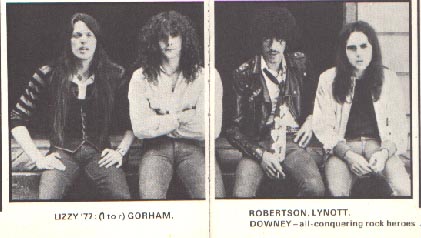
Gary actually appears on one of the tracks on the first Vertigo album. Nightlife, along with Frankie Miller of all people. but most of that album was down to the line-up which finally established Thin Lizzy as a killer band. Phil and Brian Downey were there, of course, as a supersolid rhythm team, and they were joined by the amazingly accident-prone Brian Robertson, who was a Scotsman. and the smooth Californian. Scott Gorham, who formed a formidable twin lead guitar spearhead. Once again, the world was somewhat underwhelmed by the album, but the bones of today’s live Lizzy extravaganza were beginning to grow, with songs like ShaLa-La. Showdown and Still In Love With You,
If you’re wondering why there’s been no explanation of the previous careers of Gorham and Robertson. the explanation s simple — neither of them had been in any notable bands before they found fame with Lizzy. In fact, the only interesting point to note is that Scoff is related to Bob C. Benberg. the drummer of Supertramp . . Nightlife was released in November 1974. and almost a year later came Fighting. which also includes a couple of present day stage favourites in Suicide and Bob Seger’s Rosalie, one of the few songs featured by Lizzy which didn’t emanate from within the group
It wasn t until May 1976 that Thin Lizzy began the surge towards superstardom which continues to this day. and that kick-off time produced the first gold album in Jailbreak, which also included the big hit single which has almost become the group’s anthem. The Boys Are Back In Town. Also included were Emerald and Brian Robertson’s Cowboy Song. and it seemed as though one of the reasons for the album’s success was that Phil Lynoft had taken a backward step in production, leaving it to John Aback rather than doing it all himself. Later in that year. the title track from the album also came out as a single. and was a minor hit, and in November 1976, the same team returned to the same studio. Ramport. which is owned by the Who and situated in Battersea. and put down Johnny The Fox. While this album wasn’t quite as successful as Jailbreak, which had stayed in the LP charts for nearly a year. it also produced a top twenty single in Don’t Believe A Word
SUPERSTARDOM
In January 1977. however, the band suffered what might. for a lesser group. have been a crippling blow. Brian Robertson injured himself so badly that he was unable to go on Lizzy’s major American tour. where our subjects were supporting Queen, and as often as not. making Freddie and his friends work hard to avoid being blown off stage. When they got back here. it was announced that Brian would be leaving the band to go solo, while the dude who replaced him on the U.S tour. Gary Moore yes. the same one againl would be returning to his normal position with Colosseum. Nevertheless. Phil, Scott and Brian Downey went over to Toronto, where they had decided to record their next LP. with Tony Visconti. of Bowie and Bolan fame. as producer. While they were there, Brian Robertson came over to help. and by the time Bad Reputation was complete. he d more or less rejoined the band.
The album got higher in the chart than any of its predecessors. hitting number four, while the single Dancing In The Moonlight, was also a big success. Also around this time. or perhaps a little before. Lizzy’s previous record company. Decca. released a series of compilation albums of old material, one of which. not unnaturally. featured Thin Lizzy. Now it’s normal in these cases for the artist concerned to know nothing of compilations released by previous record companies — Dave Edmunds. for instance, only heard about a coupIe of albums of his early work when he saw them in a record shop — but of course Phil Lynott is far from your average rock star. When he heard what Decca had in mind, he arranged to re-record a lot of the material, and overdub extra passages. while also choosing the tracks himself. The immediate result was Remembering Part One, an excellent document of those first days of Thin Lizzy. but tidied up to sound closer to now than to when they were originally recorded. And that. by the way. is the only Lizzy album which includes Whisky In The Jar, while a second volume of similarly old material. under the title The Continuing Saga Of The Ageing Orphan was released early in 1979.
The clincher, the album which placed Thin Lizzy firmly in the top half of the First Division of British bands was their 1978 double live album, Live And Dangerous. This was the equivalent of a double album of the best of the band, including all their recent hits and with all the onstage favourites. but recorded dynamically live, with all the extra experience and excitement that continued performance of their great songs was bound to produce. On its release in the middle of 1978, it roared to the top of the chart. and stayed there throughout the summer, selling enough for gold status twice over, and also winning precious metal in Australia, New Zealand and Japan very quickly. At the end of last year. yet another crisis occurred in fact. a pair of them together! First off. Brian Robertson’s itchy feet finally led him to say goodbye to the band. but of course, there was a ready made replacement in Gary Moore. who, since Colosseum had finally bitten the dust was very happy to rejoin permanently the group he’d previously helped out on a temporary basis.
Perhaps that move was a little predictable, but far less so was that Brian Downey. along with Phil a founder member of Lizzy. was unable to go with the band on their autumn tour of America. as he had personal problems. or as his publicist put it - a family crisis His replacement for the tour was drummer Mark Nauseef, who had previously worked with Ian Gillan.
But still Thin Lizzy continue, winning new fans and delighting their old followers wherever they go Phil Lynott’s even had a couple of volumes of his poetry published — that’s not normal for a rock ‘n’ rolling stud. eh? The next major item in the Lizzy story should be a solo album from Phil. and that’s really something to anticipate with some eagerness.
