Give Us Moore
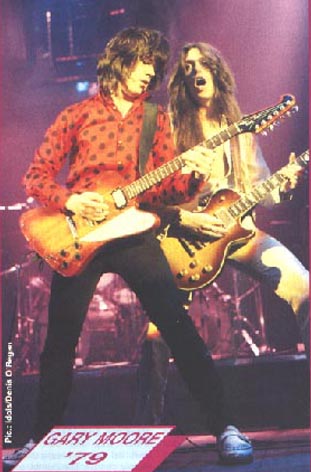
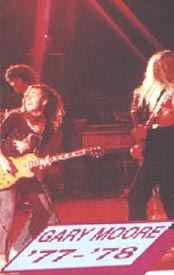
Eric Bell left the band. stating that touring was ‘damaging his health'. He went on to play with the Noel Redding Band. (I remember Noel, Eric and myself in Noel's cottage in Ireland once. laughing at the Bay City Rollers on Top Of The Pops. The consensus then was that the Rollers didn't know what was coming to them). He also played with Skid Row and a formed his own Eric Bell band. His place in a reformed Lizzy would be taken by the dazzling guitar virtuoso. Gary Moore. Getting a little older and a lot better all the time. Gary joined, for the first of three stays in January 1974. But us before that. at 4.30 a m. on the morning of January 1, manager Chris Morrison received a call from Belfast. It was Phil. recounting the disaster at the New Years Eve gig. He was ready to pack in the band but Chris talked him out of his mood of defeatism He also explained that as Thin Lizzy were in a serious financial situation they would have to keep working to pay off their debts. Phil agreed. He dad begun to think about his favourite guitar player again Gary Moore had left Skid Row to form his own band but it wasn't working out. He thought he might agree to an offer to join Thin Lizzy, the band that had known the delights of the top 10. Gary readily agreed to pick up the pieces of the Lizzy tour and flew to Ireland the next day. He was given plenty of solo space as well as being expected to back up the established Lizzy material. The formula seemed to work well and Gary became a permanent member. He was promised Lizzy would get down to serious rehearsals to come up with new material. Unfortunately the band spent most of it's time boozing and having wild nights on tour. That was okay to a point, but Gary wanted to get down to some serious business too. He had his own career and reputation to worry about.
|
|
The arguments began. but eventually they went into the studio to start recording and came up with one high powered rocker
called 'Little Darling'. They were even going to start rehearsing, but Gary had had enough and quit the band. The management were pretty furious with Gary although they were glad that they didn’t have to cope with his alleged tantrums and wild behaviour’. Gary himself always maintained that the reason for the split was entirely to do with musical reasons. As for partying, well he could keep up with anybody on that score. At this point manager Ted bowed out and Chris Morrison had to put together a German tour, with a two piece band. They brought in two guitarists, Andy Gee and John Caan But they did not
really work out and couldn't deliver the dual guitar sound that Phil had In mind and would be the Lizzy trademark for years to come. After the dodgy German tour now Brian Downey threw in the towel and this left Phil completely devastated and dispirited Guitarists had come and gone but Phil had always relied on Downey to see him through. Maybe it was the shock of having to play as a two piece. Whatever the reason, Downey wanted to go home to Ireland. But by June 1974 Phil and his manager had managed to recruit two promising young guitarists, and at the same time they convinced Brian - with the help of a pay rise - that he should stay on to give it one more try. The new guitarists were the charming, good looking and laid back Scott Gorham from California and the wild, fiery but good humoured Scot, Brian Robertsom known as
Robbo. Robertson was just 18. brash, impatient and without much respect for authority. But he was a brilliant guitarist and somehow the two disparate players became a perfect team for the revamped Lizzy. The chemistry somehow worked, even though it would give Phil many headaches in the years to come.
Just a week after the new guitar team being put into place they were booked into playing a
showcase gig at London’s Marquee for the record industry. But first they did some warm up dates and then played the Marquee which was a great success and resulted in their being signed to Phonogram. The next step was to produce their first album for the new label, which was called ‘Nightlife’. produced by Ron Nevison. and released in
November 1974. There were three tracks left over from Gary Moore. including his epic blues Still In Love With You and so it was hard for the newcomers to establish their identity It was their first stab at recording and felt the producer could have been more sympathetic Said Scott Gorham some years later ‘Nevison wasn’t sympathetic to us at all. It was the first album for Brian and me, and he didn’t bother finding out what we were all
about'. The producer was more used to dealing with artists he could dominate and got vexed at the new band's inexperience However Phil could see the potential and felt Brian and Scott were breathing new life into the Lizzy concept. which became very apparent to fans
who saw them on their first British dates. I remember going to see the new band rehearse. in a town hall in West London. and hearing Scott and Brian roaring away at full volume, while Phil smiled in delight at his new
charges. Later we adjourned to a nearby pub and I don’t remember anymore of what happened, except for Scott and Brian jumping around like schoolkids on a picnic!
|
|
|
The first official gig was at Aberystwyth University on October 4 1974 and the band played a whole lot more U.K. dates to promote the album. ‘Nightlife’ wasn’t a huge hit but it showed the way and band and management could concentrate on building up their image. They could also work on their next album which proved to be their best so far, ‘Fighting’ released in August 1975. It's standout track, ‘Rosalie’ wasn’t a hit until it was released as a live version in 1978. During the year they did a June tour which culminated with a headlining gig at the Chalk Farm Roundhouse and a show at the New Victoria, London.
Said Phil: “Within six months of being formed. we knew exactly where we wanted to go. We toured a lot and that really sorted us out” They impressed on Robbo the need to wear good stage gear and to pose for pictures and gradually the facts of rock life began to sink in. But this was not without a rear guard action from Robbo. He turned up with a five day growth of beard for the photo session for the ‘Fighting’ album cover. Phil insisted that the beard be shaved off, despite
Brian's protests that it made him ‘look older' The new album defined the Lizzy sound and
image, and featured hard rock with good melodic tunes. delivered by street wise guys led by Mr.Johnny Cool himself, Phil Lynott. Now the public began to really take notice and forget the shambolic Whiskey In The Jar’ era. They could relate to the dual guitars. a sound that had previously been the forte of Wishbone Ash. and going back in time. the Yardbirds with Jeff Beck and Jimmy Page. But with Thin Lizzy. the twin guitars meshed into an irresistable harmonic chorus. The combination of all these all these
influences and forces would reach their apogee in the album Jailbreak
The Boys Are Back In Town
Their sixth album included the song that became an instant classic and summed up the
whole image and appeal of mid-Seventies Thin Lizzy - ‘The Boys Are Back In Town', It was so simple but it was so
right. with its cascading urgent. instantly hummable guitar chorus and the insistent. lyrics warning of mayhem to come Another classic on this was Emerald. The album burst upon the world in March 1976 and made the band international rock stars at last. It seemed like all their dreams
had come true. as rock historian Pete Frame has noted: Brian Robertson began the most extraordinary hide
and seek relationship with the group This strange behaviour was apparentiy precipitated by a
brawl at the Speakeasy during the course of which Brian severed an artery in hs
hand.
Indeed young Bran had become so emotionally out out hand he had been sent back home to Scotland for a while to recover. However Brian and Scott excelled themselves on Jailbreak, produced by John
Alcock.
 |
 |
Phil song’s too were brilliant, an evocation ot boys heading for a night on the town and searching for romance in a tough world.
These particularly appealed to American audiences who warmed to the band as they started touring the States. The first tour was not without its problems however. While the band were on a roll, playing wise, they were also living it up and Phil became ill suffering from a bout of hepatitis in Omaha, Nebraska which meant he had to fly back to Manchester and go into hospital.
It meant they had to miss out playing New York, a serious blow. His illness also seemed to affect their next album ‘Johnny The fox which lacked the inspiration of
‘Jaiibreak’, 'Don’t Believe A Word' from the new album was a hit (January 1977) and got to number 12 in the charts But Phil's illness and the continued misbehaviour of Robbo was cause for concern Said Phil: "I contracted a disease I knew could put you of of business completly. It scared me because
I had never been ill before suddenly I was catching every bug going When I got hepatitis
I became a half strength person. The doctor told me to give up drugs, sex and alcohol. Give up all that. No way. So I gave up half of them. I wont tell you which half. The illness made me very sensible."
Unfortunately Robbo wasn't being very sensible and the night before they were due to fly to America for a tour, he suffered his injury at the Speakeasy when somebody went for him with a bottle. The U.S. tour was cancelled and it hurt the bands credibility in the States to such an extent the management had to fly over on a damage limitation exercise. They set up a support slot for Lizzy on a forthcoming Queen tour of the States. This was due in January 1977 but although Brian’s hand had healed, Phil did not want to take him on the tour. He was out of the band, and Phil planned to replace him with his old partner Gary Moore.
Gary had been playing with Jon Hiseman’s powerful jazz-rock combo Colosseum, where his musical skills had been pleasantly stretched. But despite his loyalty to Jon he could not resist the idea of getting back into the
rock'n’roll limelight and readily agreed to Phil's suggestion that he rejoin Lizzy for the
second time, and to come on the U S. tour. Phil just felt that ‘‘Gary Moore is the best rock and roll guitarist in the world today’’ and after two days rehearsal. Gary arid Lizzy were back on the road together for a ten week tour
lasting from January to March . Both Queen and Lizzy played a storm on the tour, and Scott Gorham found that he could easily get along with Gary as main lead player. The plan now was to record a new album in Toronto with producer Tony Visconti. Unfortunately it was found difficult to resolve problems with management and record companies in getting Gary back into Lizzy on a permanent basis. "Things got messy before me and Phil had a chance to sort things out."
This left the band without a lead guitarist They tried asking Brian May if he could
help out. But then it was decided to put the spotlight on the otherwise reticent Scott Gorham He was asked if he would like to play the leads. and apart from a few bits added by Robbo. who flew to Toronto. Scott
delivered the goods on the new album ‘Bad Reputation' the critics loved the album and it went down well in America. Phil was so pleased he relented and allowed Brian Robertson back into the fold.
At first everything seemed to go smoothly He rejoined in July on a full time basis and rehearsed with them for a headlining spot at the Reading Festival. A UK tour in November and December 1977 included two nights at Lewisham Odeon and two nights at Hammersmith Odeon. Earlier they had played a European tour and the band fired on all cylinders at some Huge festival gigs But when they got back to
America trouble started again. They were supported by the then hip band Graham Parker and the Rumour who were very popular in New York
for some reason. As a result when Lizzy the headliners came on half the audience walked out as soon as the Lizzy men hit their power chords.
It was an unhappy experience and Scott Gorham commented "By the end of that year my head was fried I
didn’t know what kind of vegetable I was. We were on the road for nine months and it began to affect me . I was always the mediator. the guy who kept cool. But with all that work I just didn’t care I just wanted to go home. It was just about the lowest ebb I had reached in the band".
 |
|
Meanwhile the fans generally had no inkling about such inner problems. They only wanted more music and they got it with the album ‘Live And Dangerous' which was released in June 1978.
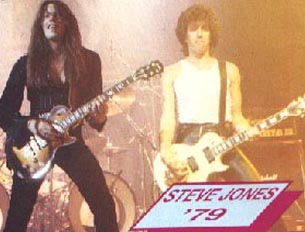
It was a big selling album and to promote it the band played two nights at Wembley Arena and both shows sold out within hours of the tickets going on sale, an indication of the band’s enormous popularity at home. But these shows proved to be the last that Brian Robertson would play with Lizzy. He departed to form his own band Wild Horses, with Jimmy Bain, and he was replaced by Gary Moore. on his third visit to Lizzyland.
In August 1978 Thin Lizzy celebrated their tenth anniversary and were hailed as one of the most
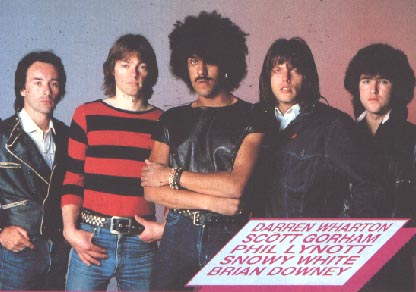
popular and hard working bands in the country The line up just to recap then included Gary Moore
(guitar) Brian Downey (drums). PhiI Lynott (bass and vocals). Scott Gorham (guitar and vocals) and Mark Nauseef (drums). Mark had replaced Brian Downey for tours in September and October. and for the trip to Australia when they played at the Sydney Opera House.
(Where incidentally they played much better at the soundcheck than they did at the gig!) The reason for Brian Downey’s departure at the time was given as ill health’ but it later transpired he didn’t like the idea of Phil forming the Greedy Bastards with Jimmy Bain. the Boomtown Rats and various Sex Pistols. It was Phil’s response to the threat posed by the punk movement, although the Sex Pistols (Johnny Rotten excluded), were all rock fans!
Brian therefore refused to go on an American tour such was his disillusion with way things were being handled, and Mark Nauseef was brought in on a temporary basis. But Phil and Brian had come a long way together and it wasn’t
long before Downey was back for the first album to be recorded with Gary Moore, called ‘Black Rose’ released in April 1979. This was very much a celebration of their Irish roots, with many jigs and reels and Quite a few hits including ‘Waiting For An
Alibi', 'Do Anything You Want' and 'Sarah'.
But the wide variety of styles on the album unsettled fans and the partying going on during recording alarmed Gary Moore and Tony
Visconti. It was recorded in Paris where the clubs proved a fatal attraction and there were many after hours drinking sessions
It was Gary’s first album with Lizzy and he wanted the guys to take things
seriously - and not just seriously take things!
Rather like Eric Bell before him. Gary cracked under the pressure and suddenly quit the band in the middle of the US tour He was expected to
play In Los Angeles but he just did not turn up for the gig. He had come to the end of his tether as far as Lizzy was concerned. It may have been that he just got fed up with Phil’s laisse faire approach to gigs. He’s was the pro who wanted to get on with the playing. and not spend time chatting to audiences and telling jokes the way Phil liked. The latter was perhaps reverting back to his Dublin folk club gigs. Gary had his eyes on hard nosed rock stardom.
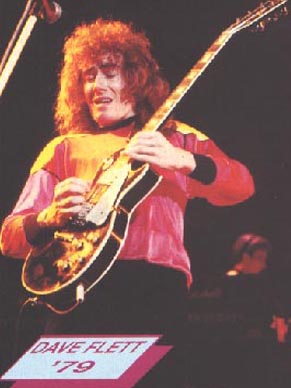
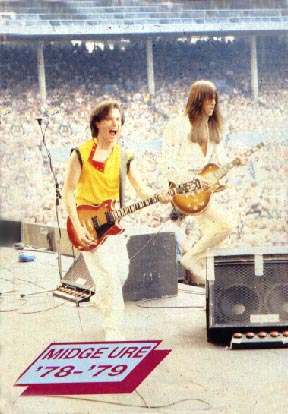
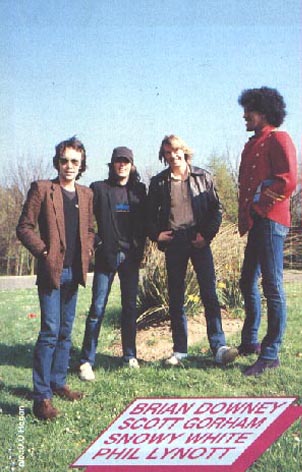
Once again Scott Gorham had to take over as lead guitarist and they did a few gigs as a three piece. supporting Journey. Then they invited the unlikely Midge Ure in on guitar. The Ultravox man helped out on a temporary basis and Lizzy also tried out Dave
Flett who had played with Manfred Mann. Dave did a Japanese tour but he too was ultimately regarded as a stopgap measure. However he stayed on with the band while the next permanent man Snowy White was
drafted in in 1980.
 |
 |