"HE DEFINITELY WAS ONE OF THE LADS"
Bono talks to Stuart Bailie about Phil
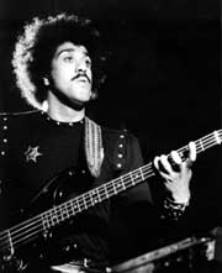 Lynott,
Thin Lizzy and the thrill-power of Dublin's first superstar
Where do Thin Lizzy fit in?
How do they matter in the sphere of rock and roll?
Well, I can't tell you in terms of the history of rock and roll music where Thin
Lizzy fit in. I can tell you where they fit in in my life. Which was the
combination of machismo and lyricism, is actually what did it for me. Because
when we were kids, Van Morrison was for grown ups. He still steeped through and
I couldn't imagine life without him, and since then I've caught up with him, and
I think he had a huge influence on Thin Lizzy... but (with Lizzy) it was the
grrrr that was leading up to punk rock. When you're 15 and16, you just want to
crash the car, to hear those power chords and all of that. And so you had a lot
of these metallic groups that had that power, but none of the lyricism, and Thin
Lizzy had both.
"Thin Lizzy on Top Of The Pops was like Ireland being in the World Cup.
That's the way it was. And so they became the centre of the universe for people
who were writing about rock and roll or writing in rock and roll. I know they
really helped The Boomtown Rats, and indeed, they helped us too, here and there.
"I know Adam thought that Phil Lynott would be his way to win the world.
Because Adam was managing U2 at the time and he rang Phil at, I guess it was
about eight in the morning, after their gig in Dalymount Park. He hadn't quite
figured out yet, that rock and roll people don't get up at eight o' clock. So I
think Phil might have told him to fuck off. I think Adam has since figured it
out, as he himself is not an early riser.
"But that was it: they were over the wall and for anyone else on the other
side, you're gonna ask them how they did it."
You listened to Thin
Lizzy's 'Live And Dangerous' for clues about stage performance, didn't you?
"Yeah, we did. It was a great, great live album. 'Live And Dangerous' was
amazing. It was the blueprint for a live record that would have a beginning, a
middle and an end. And that's the way U2 still approach playing a show. We want
the whole to be more than the sum of the parts. It was this concoction of
romance and aggression that just took you away.
"I come from an area in the northside of Dublin between Ballymun and
Finglas. It was a nice little street, but things could get rough, and that was a
thing, again, that Thin Lizzy seemd to reflect that aggression, just hanging out
on the streets. You couldn't dodge it really. People have said that he glorified
it, but I think in that sense he was just being a journalist, that's the way
things were. I think that gave them their status as boys' band as well. There
were in those days, boys' bands and girls' bands."
You lived for a while
in Howth, near Phil's home, didn't you?
"I used to meet Phil Lynott around, and he was quite the rock star. And I
was an apprentice. I still feel like an apprentice rock star. It's a part-time
job for me; the swagger and the attitiude. But it wasn't for him - he was
full-time at it. And then, as the years went by, he got a house in the northside,
in a place called Howth. I lived about four doors up from him, in a little three
room cottage which was U2's rehearsal room. I used to bump into him a lot there.
And he used to say; 'we have to meet up, we'll go out for dinner', and I didn't
quite know how to react to that. I didn't follow up on that ever. I was kind of
in awe of him, I think that's what it was. I didn't know what I'd say, if I was
sitting down in Philo's house.
"But there was another side of it too, which was that he'd really gotten
into the lifestyle of self-destruction at that point. I guess we were a bit...
not just naive, but kind of anti that. I didn't like to see what he seemed to be
doing to himself. When he died, I must say I really resented the fact that I
hadn't dropped in to see him more often. Because maybe he was looking for some
people who were outside of his scene, I dunno. He was probably just being a good
bloke, decent to the youngster that was up the road."
Was Phil a 'Dub', and
if so, what is a 'Dub'?
"I dunno what a Dub is. People would would always say Philo was a Dub
because he talked like that. My old man is a 'Dub'; my family on both sides grew
up in a place called Cowtown. you couldn't get more Dub. But I think it's a bit
of a cliche, the Dub thing. He definitely was one of the lads, and though that
might have been part of his appeal when I was 15 or 16. But in the end it was
the lyricism of records like 'Shades Of A Blue Orphanage' that actually got to
me. So the machismo in a way was how he got away with being able to be so raw,
emotionally on those records.
"And in the later years, when he used to write those ballads for his
children, he barely got away with it. But becasue he was a Dub and one of the
lads, people could actually excuse him wiritng a song for his baby. I'm so glad
he did it. From how I see it, it was a very rock and roll thing for him to do. I
thought he had real balls to do that."
U2 supported Thin
Lizzy at Slane Castle in 1981. Was there a rivalry between the upcoming
youngsters and the established band?
"I've heard that. Our sound was shite, and I think people were saying that
they wouldn't give us the full run of the desk and things like that, and that
Philo was a little nervous. I can't believe that, to be honest, because we were
actually just crap. I don't think it was anything to do with the sound desk. We
walked out on that gig in Slane Castle and played a load of songs that we'd
never played before. We opened with uilleann pipes on a song called 'Tomorrow',
and I think it's much more a case that we were a mess.
"But there was a bit of rivalry between the old guard and the new guard.
Even though we weren't a punk rock group, we were part of a new wave of groups
with their fingers up to the younger groups. And I think that's where that story
came out of, that there was a bit of a tangle. But I don't think so."
A lot of Phil's
songs reveal a person who was sensitive about illegitimacy and the father he
never knew. Yet his stage personna never gave any of that sadness away. Did you
ever see the façade crack?
"Personally, I never saw into his more fragile side that you can hear it in
the songs, and what people tell me they saw in him as a person. I saw him
occasionally out in clubs, looking a little worse for wear. And apparently in
those times, he was brutally honest about what it was that made him tick. But he
never was to me.
"It's the classic rock and roll story, isn't it? It's usually a mother, but
in his case it was a father, leads to this desperate attempt to identify
yourself. If you lose a mother or a father that's what it is. it's true from
Johnny Lydon to John Lennon to Phil Lynott... even myself. There is some drive
to find out who you are, in the absence of not fully knowing, that leads to the
kind of person who will write books or paint pictures. But more so to make the
kind of noise that rock and roll throws up."
And your
favourite Thin Lizzy music?
"I love that album 'Shades Of A Blue Orphanage'. It had all those poetic
references. There was that moment where people were tying in rock music with the
Celtic Twilight and all of that. That was a brave and bold move that he got
started there. It hasn't been fully picked up on, and I think it will be at some
point. I think that's my favourite.
"But the glam rock side of them was great too. Even thought they never wore
glitter, they had that glamourpuss thing that hasn't dated. They don't look as
ridiculous as a lot of the glam rock groups. And here again is something that is
the most defining difference about them, was this silky voice that he had. He
was never a screamer and there was a sexuality that I think was much more
evolved than the usual Viking,
beating-of-the-breast-and-I'll-bite-your-head-off-missus, side of the other
bands, y'know?"
contents