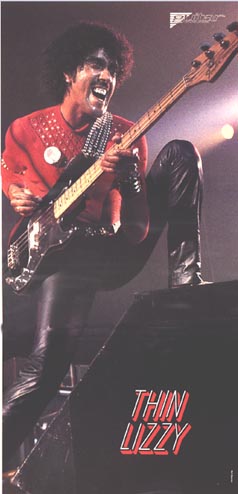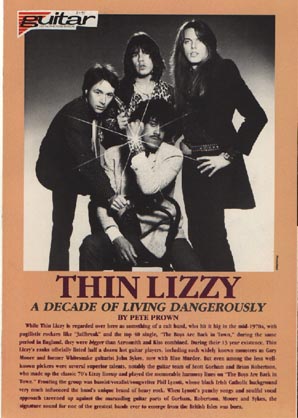
Reprint from the US 'Guitar' mag of Feb 1991. A pullout entitled:
Thin Lizzy
A Decade of Living Dangerously
by Pete Brown
|
While Thin Lizzy is regarded over here as something of a cult hand, who hit it big in the mid-1970s, with pugilistic rockers like “Jailbreak” and the top 40 single, “The Boys Are Back in Town,” during the same period in England, they were bigger than Aerosmith and Kiss combined. During their 13 year existence, Thin Lizzy’s ranks officially listed half a dozen hot guitar players, including such widely known monsters as Gary Moore and former Whitesnake guitarist John Sykes, now with Blue Murder. But even among the less well-known pickers were several superior talents, notably the guitar team of Scott Gorham and Brian Robertson, who made up the classic 70’s Lizzy lineup and played the memorable harmony lines on “The Boys Are Back in Town.” Fronting the group was bassist/vocalist/songwriter Phil Lynott, whose black Irish Catholic background very much influenced the band’s unique brand of heavy rock. When Lynott’s punchy songs and soulful vocal approach careened up against the marauding guitar parts of Gorham, Robertson, Moore and Sykes, the signature sound for one of the greatest bands ever to emerge from the British Isles was born. |
THE EARLY YEARS, 1970-1974
During the early-1970s, Thin Lizzy was a heavy psychedelic blues trio influenced as much by Irish folk music as by the great Jimi Hendrix. On the Decca label, they recorded three albums, including the stellar Vagabonds of the Western World, with original guitarist Eric Bell, who left the band in early 1974, collapsing onstage at a New Year’s Eve gig. Shortly thereafter, Bell was replaced by another Irish picker, Gary Moore, who had originally been with Skid Row (not to be confused with the popular metal band from New Jersey) and his own Gary Moore band. Moore, however, only came aboard for a six-month stint of touring and scattered recording sessions before leaving to join Colloseum II, a fusion band led by drummer Jon Hiseman, with whom he did three albums in the mid-70s. While the Bell and early Moore eras are fascinating in the context of Thin Lizzy’s entire history, and have been ably summed-up on two compilations, Remembering, Part One (containing Bell’s guitar extravaganza “The Rocker” and Moore’s whiplash leads to “Little Darling”) and The Continuing Saga of the Ageing Orphans, the Thin Lizzy of that period doesn’t particularly sound like the one fans came to know through popular albums like Jailbreak or Black Rose. Despite being overshadowed by the incredible sound that was to come, there’s no question that much of Thin Lizzy’s early material was often extraordinary and, at times, even revolutionary for its day.
BIRTH OF A SOUND, 1974-75
Scott Gorham and Brian Robertson joined Thin Lizzy in 1974, after Moore’s sudden departure. Both Gary Moore and Eric Bell had experimented with overdubbed harmony guitars on various Thin Lizzy songs during their tenures, which likely prompted leader Phil Lynott to beef up the band’s live and studio sound with two full-time guitarists. First to join was Robertson, who came down from Glasgow, Scotland to land the gig after auditions by fifteen other players. Next in was Californian Gorham, who had just come to England in search of a gig on the advice of his brother-in-law, who played with the British pop group, Supertramp. Both Gibson Les Paul users (Robertson played Customs and Standards, Gorham mostly Deluxes), these two pickers would go on to define the patented Thin Lizzy guitar sound of tight harmony lines and competitively hot solos. However, their first attempt at it, 1974’s Nightlife, missed the mark entirely, as the album inadvertently captured the band in a soft rock mode, far from their real heavy rock persona (Gary Moore appears on one track here, soloing on the stately ballad “Still in Love with You”). The following year’s effort, Fighting, was a noticeable improvement, finally showing some of their live aggression in cuts like “Suicide,” “Fighting My Way Back,” and a cover of Bob Seger’s “Rosalie.” But despite the dramatic improvement, Fighting still portrayed a band in search of its identity
.
JAILBREAK & JOHNNY THE FOX
It wasn’t until 1976 that Thin Lizzy really began to get their songwriting and tandem guitar work in order. Two years of hard touring had tightened up their overall musicianship, and the effect can be readily heard on the album Jailbreak. With this Lp, leader Phil Lynott had finally grown into a consistently strong writer, contributing a number of gems, including the title track, “The Cowboy Song,” and of course, The Boys Are Back in Town.” Still, the Thin Lizzy singer took some heat from the press for supposedly sounding too much like Bruce Springsteen, who was riding high with Born to Run. But considering that Lynott was already an established artist by the time of Springsteen’s first album in 1973, the comparison seems groundless in retrospect. Some of Lynott’s accomplished bass work was lost in the final mix of Jailbreak, but Gorham’s and Robertson’s guitar playing stood strongly out on the finished product. Stylistically, Gorham tended to take more of the melodic lead sections, while Robertson leaned towards high-energy frenzies, but both players frequently crossed into the other’s territory. Gorham’s tasteful style can be best heard in his double-tracked solo to “Romeo and the Lonely Girl,” while Robertson indulged heavily in wah-wah effects on “Warriors.” The guitarists also traded solos in the Celtic-tinged 6/8 rhythms of “Emerald,” and split two absolutely blistering breaks on “The Cowboy Song,” another big concert favorite. And to this day, Gorham’s and Robertson’s fluent harmony lines on “The Boys Are Back in Town” remain the quintessential Thin Lizzy guitar trademark. After finally getting a taste of success with Jailbreak, Thin Lizzy wasted no time in getting another album out, called Johnny the Fox, released towards the end of 1976. Side one kicked off with two molten rockers, “Johnny” and “Rocky,” both of which feature samples of Brian Robertson’s screaming lead work, while Scott Gorham cooled out “Fool’s Gold” with an immaculately composed solo. It was also around this time that Thin Lizzy toured the U.S. as an opening act for Queen. This infamous tour featured each band blowing the other off the stage on alternate nights, Lizzy’s twin-powered guitar lineup pitted against Queen’s Brian May, in what many remember as a truly electrifying heavy guitar showdown.
BAD REPUTATION
In 1977, Thin Lizzy topped the bill at Britain’s popular Reading Festival, headlined an American tour, and issued their eighth album, Bad Reputation. In songs, arrangement and production, Bad Reputation was a huge improvement over both Jailbreak and Johnny the Fox, but what is of particular interest is the fact that Brian Robertson only appears on three cuts, and then only adds solos, Robertson was reportedly having substance abuse problems, thus leaving the bulk of the guitar playing to Scott Gorham. Fortunately, Gorham rose to the occasion, and turned in perhaps his most impressive performance with Thin Lizzy. Further, the band’s sound was dramatically enlarged and improved under the production and engineering talents of longtime David Bowie producer Tony Visconti, who proceeded to work out all the studio kinks that had plagued previous Lizzy recordings. There were no more lost bass parts, tiny sounding Marshall stacks or flaccid snare drums; for the next few years, Thin Lizzy would be at the peak of their creative powers, and with Visconti at the helm, their clean, powerful recordings hammered that point home with a vengeance. As the album’s opener, “Soldier of Fortune,” revealed, Gorham had also greatly matured as a player, gaining enough confidence to cut all the rhythm parts, harmony guitars and solos himself. The next track, “Bad Reputation,” confirmed this, as the guitarist laid out a mean bass-string riff on top of Brian Downey’s propulsive Afro-funk drum beat. For the solo, he used a swath of thick distortion to give his swooping bends and vibrato effects a commanding authority, and fast repetitive licks to keep the atmosphere charged with energy. Then again, he could turn around and become a restrained melodicist on such lighter rock fare as “Southbound” and the UK hit, “Dancing in the Moonlight.” Though Brian Robertson was not around for much of the album’s making, he made his mark on two riveting hard rockers, “Opium Trail” and “Killer Without a Cause” (exciting live versions of both these tracks were also included on a 1981 British Ep called Live Killers). As usual, his leads are almost hyperactive, with the guitarist overbending strings, picking fast one-note phrases, and, on “Killer Without a Cause,” basically stomping the hell out of a wah-wah pedal.
LIVE AND DANGEROUS
1975 was a year of flux, as Brian Robertson’s position in Thin Lizzy became more and more questionable. In the interim, the band released a double live album culled from the UK and North American tours of 1976 and ‘77. For many bands, a live album is a chance to take a break and earn some money from old live tapes, while for others, concert recordings are a real creative statement, often showing them in their truest element. The Who’s Live at Leeds, the Rolling Stones’ Get Your Ya-Ya’s Out, and Lynyrd Skynyrd’s One More from the Road are all fabled examples of the live album at its best. As Thin Lizzy addicts know, Live and Dangerous is a member of this esteemed group and then some. Containing four sides of non-stop hard rock energy, Live and Dangerous finally let the world know how explosive Thin Lizzy was in concert. Many of the best songs from such technically limp Lps as Jailbreak and Johnny the Fox were given new life in a live context, and even the expanded live version of “The Boys Are Back in Town” was a clear improvement over the original hit version.
Guitarwise, Scott Gorham and Brian Robertson stood on opposite ends of the stage, each dwarfed by rows of Marshall 100-watt stacks and trading solo after solo on their Les Pauls, in a seemingly deliberate attempt to outdo each other. Robertson, for example, took the raging final solo in “Emerald,” gave “Don’t Believe a Word” a quick wah-wah punch, and torched the second solo of “Are You Ready,” with a surprise modulation and salvo of upper register string bends. Gorham took the low road, adding fast minor blues scale licks in his solo to “Massacre,” and firing up the second solo to “Johnny the Fox Meets Jimmy the Weed” with high intensity bends and spry blues scale runs. Together, both guitarists went for the jugular in their respective solos to “Cowboy Song,” created gorgeous harmony lines on The Boys Are Back in Town,” and in one of the record’s high points, each took long, stunning solos in the ballad “Still in Love with You.” Thin Lizzy fans...
Sorry, but this is where it ends. has anyone got the final piece?