A TRIBUTE TO PHIL
LYNOTT
BY MARK PUTTERFORD
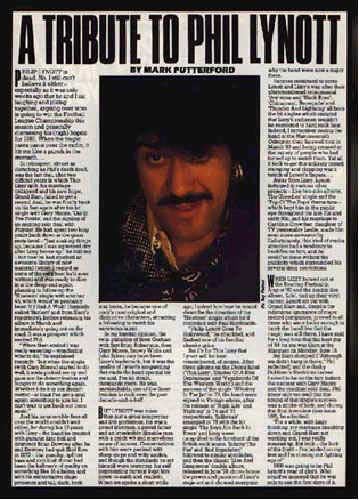
PHILIP LYNOTT is dead. No, I still can’t believe it either —especially as it was only weeks ago that he and I sat laughing and joking together, arguing over who is going to win the Football League Championship this season and generally discussing his (high) hopes for 1986. When the tragic news came over the radio, it hit me like a punch in the stomach...
In retrospect, aknost as disturbing as Phil’s death itself, was the fact that, after two difficult years in which Thin Lizzy split, his marriage collapsed and his new hope, Grand Slam, failed to get a record deal, he was finally back on his feet again after his hit single with Gary Moore, ‘Out In The Fields’, and the signing of an exciting solo deal with Polydor. He had spent two long years back down at the grass roots level — ‘lust soaking things up, because I was squeezed dry after Lizzy broke up,” he told me - but now he had stocked an awesome library of new material (which I regard as some of the very best he’d ever written) and was ready to dive in at the deep-end again, planning to follow-up the ‘Nineteen’ single with another 45, which would’ve probably been ‘If I Had A Wish’ (formerly called ‘Harlem’ and from Slam’s repertoire), before releasing his album in March and immediately going out on the road. It was a prospect which excited Phil.
“When Slam ended I was really wavering - wondering what to do,” he explained recently, “but when the single (with Gary Moore) started to do well, it sorta picked me up and gave me the determination and hunger to do something again. Whether I do it or not doesn’t matter — at least we got a goal again; something to aim for. I can’t wait to get back out there again.”
And his innumerable fans all over the world couldn’t wait either, for during his 13 years with Lizzy - the band he created with guitarist Eric Bell and drummer Brian Downey after he and Downey had quit Skid Row in 1970— that punchy, upfront bass and rich Irish throat had been the hallmark of quality on something like 16 albums, and with his authoritative stage presence and tall, dark, rock star looks, he became one of rock’s most original and distinctive characters, attracting a following to match his enormous talent. In my humble opinion, the twin-guitaring of Scott Gorham with first Brian Robertson, then Gary Moore, Snowy White and John Sykes may have been Lizzy’s trademark, but it was the quality of Lynott’s songwriting that made the band special for me and, I’ve no doubt, thousands more. He was, unmistakably, one of the finest lyricists in rock over the past decade-and-a-half.
BUT LYNOTT was more than just a great songwriter and live performer. He was a proud Irishman, a proud father and an irresistibly likeable man with a quick wit and marvellous sense of humour. Conversations with him were packed with sharp quips and witty asides, and though the standards he set himself were towering, his self-deprecating humour kept him down-to-earth and realistic. When we spoke a short while ago, I asked him how he would 1 describe the direction of the ‘Nineteen’ single which he’d recorded with Paul Hardcastle. “Philip Lynott Goes To Hollywood,” he chuckled, and flashed one of his familiar cheeky grins.
But it’s for Thin Lizzy that Lynott will be best remembered, of course. After three albums on the Decca label (‘Thin Lizzy’, ‘Shades Of A Blue Orphanage’ and ‘Vagabonds Of The Western World’) and the success of the single ‘Whiskey In The Jar’ in ‘73, the band were signed to Vertigo where, after the release of ‘Night Life’ and ‘Fighting’ in ‘74 and ‘75 respectively, ‘Jailbreak’ emerged in ‘76 with the hit single ‘The Boys Are Back In Town’ and Lizzy were catapulted to the forefront of the British rock scene. ‘Johnny The Fox’ and ‘Bad Reputation’ followed to similar accolades, and then the classic ‘Live And Dangerous’ double album, released in June ‘78, drove home the power and passion of Lizzy’s stage act and showed everyone why the band were now a major force.
Success continued to come Lynott and Lizzy’s way after their aforementioned monumental ‘live’ opus and ‘Black Rose’, ‘Chinatown’, ‘Renegade’ and ‘Thunder And Lightning’ all bore the hit singles which ensured that Lizzy’s audience wouldn’t be restricted to hard rock fans. Indeed, I remember seeing the band at the Hammersmith Odeon on their farewell tour in March’83 and being amazed at the variety of people who had turned up to watch them. Yet all it took to get this unlikely crowd stamping and clapping was a twitch of Lynott’s fingers…
Away from Lizzy, Lynott indulged in various other projects — like two solo albums, The Greedies’ single and the ‘Top Of The Pops’ theme tune —which kept him in the public eye throughout the late 70s and early 80s, and his marriage to Caroline Crowther, daughter of TV personality Leslie, made him even more newsworthy. Unfortunately, this kind of media attention had a tendency to backfire on him, and he could’ve done without the publicity which surrounded his several drug convictions.
When Lizzy bowed out at Reading Festival in August ‘83 and the double live album, ‘Life’, tied up their vinyl career, Lynott set out with Grand Slam and, despite the ridiculous ignorance of major record companies, proved to all those who were lucky enough to catch the band live that the magic was still there. I have said for a long time that the best gig of ‘84 for me was Slam at the Marquee on Monday, June 18. But Slam slumped (“Although we didn’t hang in there,” Phil reflected) and the dusky Dubliner’s illustrious career looked to be on the turn before the success with Gary Moore and the resultant solo deal. Phil knew only too well that the timing of that single’s success was a stroke of luck, and during that final interview , he admitted “For a while, with Lizzy finishing, my marriage breaking down and Grand Slam not working out, I was really messed up. But look — the luck of the Irish! — I’ve landed on my feet and I'm coming out fighting again!”
1986 was going to be Phil Lynott’s year of glory. Who could’ve guessed that he was only to see the first days of it.